“Whoever is still…finds rest in the restless”. Lao Tzu
The Paradox of Stillness
Meditation is the art of doing nothing— and yet, in that nothing, everything begins to move. When I sit in meditation, my body appears still, with my eyes closed, and I sit in a quiet corner. But inside, it is a battle.
The film of darkness in front of my eyes was accompanied by a sudden awareness. The drum of my heartbeat, my breath, the way my leg folds, and the air that plays along the lengths of my arms.
It is like electric thunder diving deep into the depths of my own being— akin to being under a microscope.
After I win this first battle, the second battle starts. When I silence myself, my thoughts get louder. As though a hundred voices are clanging for my attention— saying, finally, now listen to me first.
It is a technique that takes years to master, and eons to win. To soothe and calm every single voice, listen to it, give it space, and let it finally rest. I’m still in the beginning stages. But the paradox of it all keeps me coming back for more.
Stillness is not the absence of motion, but the deepest form of motion. Neuroscience shows meditation doesn’t just empty the mind. It reshapes awareness, reactivity, and how our brain relates to thought.
Rumi once wrote, “There is a voice that doesn’t use words. Listen.”
Meditation As Descent
This might be a first for many. They think meditation is all about transcendence, higher vibration chakras, light, and bliss. But descent is older, wilder, and truer.
It is an adventure into the darkness, the shadowed parts of our psyche, the emptying.
The practice of Surat Shabd Yoga, within the Sant Mat tradition, is the oldest of such examples. It begins by drawing attention inward through the remembrance of the Name of God. It is a descent before ascending to subtler planes.
Henry Corbin (scholar of Sufism) wrote, “The descent into the heart is the ascent to the heavens.”
First, you must ground your roots before you can soar. By facing what lies below, in the “cellar of our hearts”, we come face to face with our fears, grief, memory, and shadow.
Once brought to light, we can sift through it in ways we should. This makes meditation a form of descent— a vital factor in our journey as human beings.
Rabindranath Tagore once said, “Faith is the bird that feels the light when the dawn is still dark.”
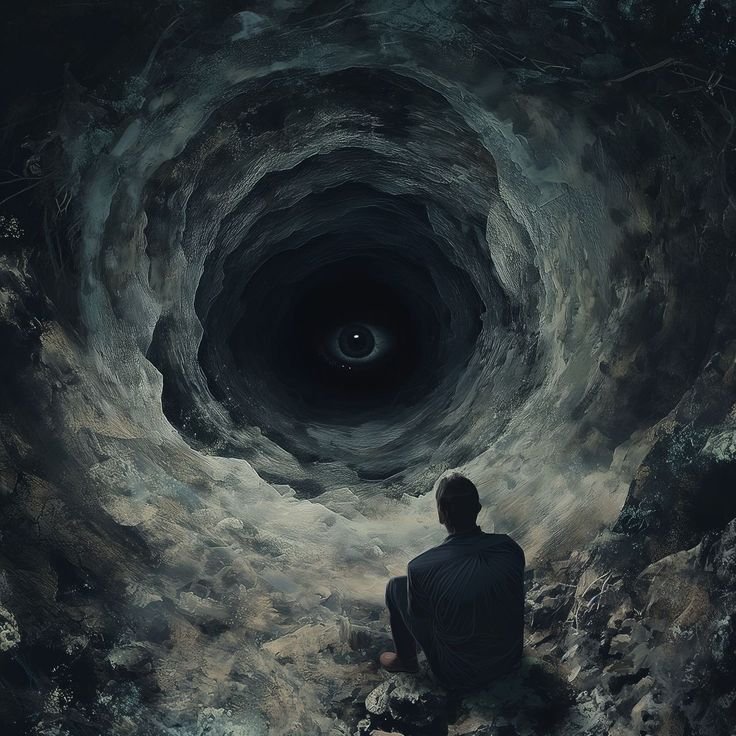

The Wild Mind As Companion
Meditation is a practice of stillness within as well as without. The wild mind is the abyss of thoughts, emotions, memories, and even fantasies that never leave. Buddhists call it the ‘Monkey Mind’— leaping from branch to branch.
In Jungian thought, it is this wild mind, also called the unconscious. It bubbles up in symbols, dreams, and recurrent archetypes. In Sufism, it is akin to ‘nafs’— the self. But the wild mind isn’t an enemy. It’s the raw, powerful energy that can either drive you mad or become your most loyal companion.
Natalie Goldberg (Zen writer) calls it “writing practice”: “Wild mind is your big sky mind. It is complete, pure, untampered with by ego or self-doubt.”
Many meditation traditions ask us to “quiet the mind”, “empty it”, or “stop it”. But the mind is no mere enemy. It is a powerful force capable of reaching the ends of the universe in one second. Or diving into a conversation about wax and candles, the next.
You will fail if you attempt to contain a seastorm in a bottle.
So instead, befriend it. Let it see the benefits of silence and stillness. Witness whatever thought it throws your way and treat it gently.
Like Zen teachers say, “Put it on the tea table, but don’t serve it dinner.”
Know that it is a part of you that is critical of meditation or whatever it is you are trying to achieve. Let its criticism come through, but do not buy into it. You are not a prisoner of it, but you do not exile it either.
You don’t tame a wolf; you walk alongside it. You learn its moods and habits, and once you see them outside of yourself, it becomes easier to understand. You let it lead you into chaos and eventually freedom.
Hafiz said it better than I ever could: “I am a hole in a flute that Christ’s breath moves through. Listen to this music.”
Meditation As A Landscape
The inner world is anything but flat and mundane. Our outside world is dotted with chores, rituals, meetings, duties, and traditions. Yet it is a dull repetition. Despite the variety, it becomes monotonous.
Likewise, meditation, like the tip of the iceberg— silent, unassuming, and yes, boring… conceals a vast hidden depth.
Once we give it regular time and practice, we will realize that our inner worlds are anything but mundane. There are valleys of stillness, lush spaces within. There are mountains of thought, restless and looming, hard to climb sometimes. There are rivers of sensation that make your breath quiver, and your heart tingle.
There are storms and winds of thought that whisk you away in memories and intrusive emotions. Meditation is not escaping these terrains but learning to walk in them all. Keeping a sense of peace and calmness, without judgment.
The poet Kabir wrote: “Between the conscious and the unconscious, the mind has put up a swing. All earth and heaven are swinging.”
Meditation is a doorway; it is a threshold. You sit, you breathe, and everything becomes porous. The ticking fan, the itch on your nose, the flicker of thought— each door becomes a beacon. It is leading you towards yourself.
It is not about arriving in silence like a prize. It is not about escaping the world into some pure state. It is about dwelling at the edge, where silence and noise dance together. The door is not somewhere else. You are the door. Sitting quietly, you learn how to open.
“Meditation is less about emptying yourself than about becoming a threshold. To sit in silence is holy. Every breath becomes a passage into the infinite.”
External Links
- For the proper technique on meditation, click here.