“The Tongue of Thought” renders consuming thought as a living presence: something that arrives before language, circles attention, and becomes almost creature-like in the imagination. This is existential poetry about the felt anatomy of a thought spiral, not a clinical definition of intrusive thoughts.
A note on language: I use “intrusive thoughts” poetically in this piece for thoughts that arrive unwanted or become consuming. In clinical contexts, intrusive thoughts have more specific meanings and can occur with or without conditions such as OCD. Disturbing thoughts do not by themselves reveal a hidden desire or intention. If recurring thoughts are causing significant distress or interfering with daily life, professional support can be useful.
When Intrusive Thoughts Become a Presence
Certain thoughts arrive without warning and consume the thinker. Are thoughts divine, predatory, erotic, or self-created? Or do those categories reveal more about the meanings we give them than about thought itself?
Before a thought becomes a sentence, it is a presence. It is a visitor that has learned to copy our key.
This piece was inspired by one of those rare moments when I was so engrossed in my own thinking that I seemed to catch a thought at the instant it began to form, watch it gather momentum, and notice what happened when I finally let it go.
That step-by-step feeling was what I wanted to capture in “The Tongue of Thought”– not thought of as intellect but as something living. Something that knocks before it arrives and enters when permission is granted.
Most of us speak of thoughts as passive things. Fleeting clouds. Passing visitors. Harmless inner murmurs.
But some thoughts do not pass. They linger at the edge of the ear like cold breath in a dark room. Some thoughts do not appear. They touch. Grasp. Consume.
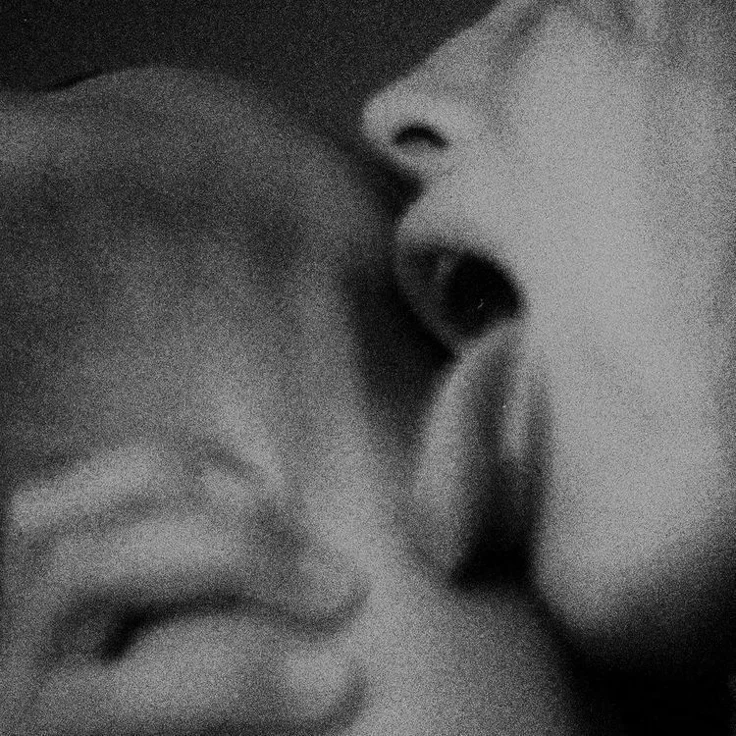
“The Tongue of Thought”
The tongue of thought is a presence unknown.
You feel it first through the tingle in your veins
and the uprooted bulbs on your arms.
A quiver, an ecstatic shiver,
that freezes time for just a moment.
You feel its cold, tingly
fingers grasp your shoulder.
Its long, salivating tongue,
announced by a cold gush of air,
right next to your ear.
You can’t move or do anything,
but fall into the trap,
the trap that’s laid out for you
by you.
A bait for life.
The tongue swirls and drools,
enters your ear, and
all through your brain.
Reaches the arches and licks them clean.
There’s nowhere it can’t go,
nowhere it can’t reach.
You follow it, wanting to stop.
To control…
and it lets you…
just for a moment.
Right when you think you got it,
it flashes and zips past to the other side.
The Tongue of Thought never stops licking…
What Inspired This Existential Poetry
Some contemplative traditions have given me languages for distinguishing mental activity from the awareness that notices it, although they do not mean the same thing by that distinction. Advaita Vedānta offers one particularly explicit vocabulary: in Śaṅkara’s philosophy, witnessing consciousness (sākṣin) is distinguished from the changing contents and activities of mind. Other Sufi, Gnostic, and esoteric traditions approach selfhood, attention, and inner observation through their own metaphysical frameworks, which I do not want to collapse into one doctrine.
What I borrow here is not a universal theology but an image: thoughts as weather passing through a field of awareness. Not every thought deserves allegiance merely because it has arrived.
Obsession
This existential poetry was born from something even more raw than this realization. It came from the experience of being inside a thought spiral, being consumed so totally that it didn’t feel like thinking at all. It felt like being swallowed by the thought spiral.
I remember sitting with a thought that spiraled and looped around my head all day. A constant background noise; it wouldn’t release me. As I sat down, wondering about the thought for the thousandth time that day, I gave up.
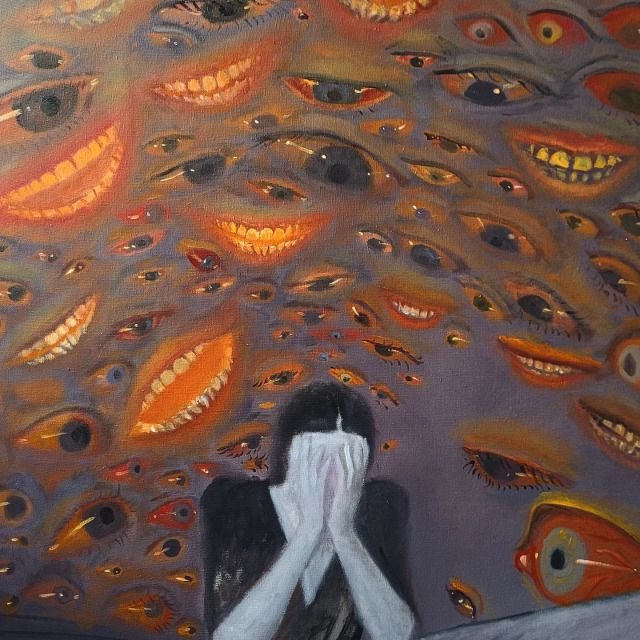
Instead of fighting the thought or feeding it more attention, I tried simply to let it be there. In my imagination, it became a body floating just outside me, tentacles latched onto my head. One image led to another until the tentacles became tongues: wet, relentless, hungry. The image entered through the ear and seemed to move toward the mind, toward sound and language, toward the very medium through which thought becomes something I can hear inside myself. It licked the arches clean. Swirled me until I felt almost drowned in it.
It was not a dark image so much as an honest one. If that is what consuming thought feels like in my imagination, no wonder it can feel so total. And beneath the image came an awareness: “It’s a trap laid out for you / by you.”
Witness Consciousness and the Observer of Thoughts
There is something in us that is addicted to suffering, a strange tendency to keep returning to a thought long after returning has stopped being useful. Something that lays out the bait and calls it curiosity, calls it processing, revisiting, “caring about things.” And the tongue, its knock answered, enters. It takes us away in its slithery wet tentacles and lets us drown in our own making.
For me, control can become one of the mind’s crueler illusions. It lets me hold the leash just long enough to believe I command everything that appears. Then another thought flashes past. Another tongue. Another tentacle.
I don’t write this to despair. I write it because thinking of thought itself as an image is the beginning of something. Beginning of coherence, never control. I cannot control every thought that appears, and trying to overpower every one of them often becomes another form of entanglement. What I am looking for instead is a different relationship to thought: enough distance to notice the wave without pretending I can command the sea.
The tongue never stops licking. It never will. But the arches it licks clean, they rebuild. The places it takes you to will take on another meaning the next time you visit. It is scary, and sometimes that small distance is where I find stillness.
Because consciousness never truly stops touching the world. Perhaps thought itself is an endless mouth trying to taste existence through us. I don’t know, but I do feel the whoosh of air as the tongue has started rearing its head on this one.
The Resonance Space
Perhaps a thought spiral has found you today. Perhaps not. When one does, the question is not always how to annihilate it, but whether you can notice it without immediately becoming identical with it.
Feel It First
Sit still for one minute before you do anything else.
Notice whatever thought arrives first, if one does.
Notice how it arrives.
Not only its content. Its texture.
Does it creep?
Does it flood?
Does it tap?
That texture is what this poem is about.
Reflect It
If you could picture the shape your thoughts take, what do they look like?
What creature, what weather, what architecture?
Where, if anywhere, do you feel a consuming thought in the body?
Where do they tighten, pulse, or sink?
Can you notice any distance between the thought and the awareness noticing it? What does that distance feel like, if it appears at all?
Write It: Your Creative Echo
Take a color. Any color that comes immediately to mind.
On a page, without stopping to think, describe your thought-self in that color.
Let it become an image, a creature, a storm. Let it be wild and exact.
Carry it with you.
The tongue keeps licking. But the arches it cleans can rebuild.
In the symbolic world of this poem, that rebuilding is what consciousness feels like to me.
Not control.
Renewal.
Wander Further into the Descent
☽ For another encounter with obsessive, shadowed imagery, read “Wolf Archetype in Women: The Shadow Self.”
☽ This poem is one echo from a larger body of work. Read Zephyr: A Collection of Poems.